Understand your requirement
Review actual bottle formats, empty and filled weights, surfaces, closures and required station orientations. Define accepted transfer/placement and the current conveyor and downstream pattern.
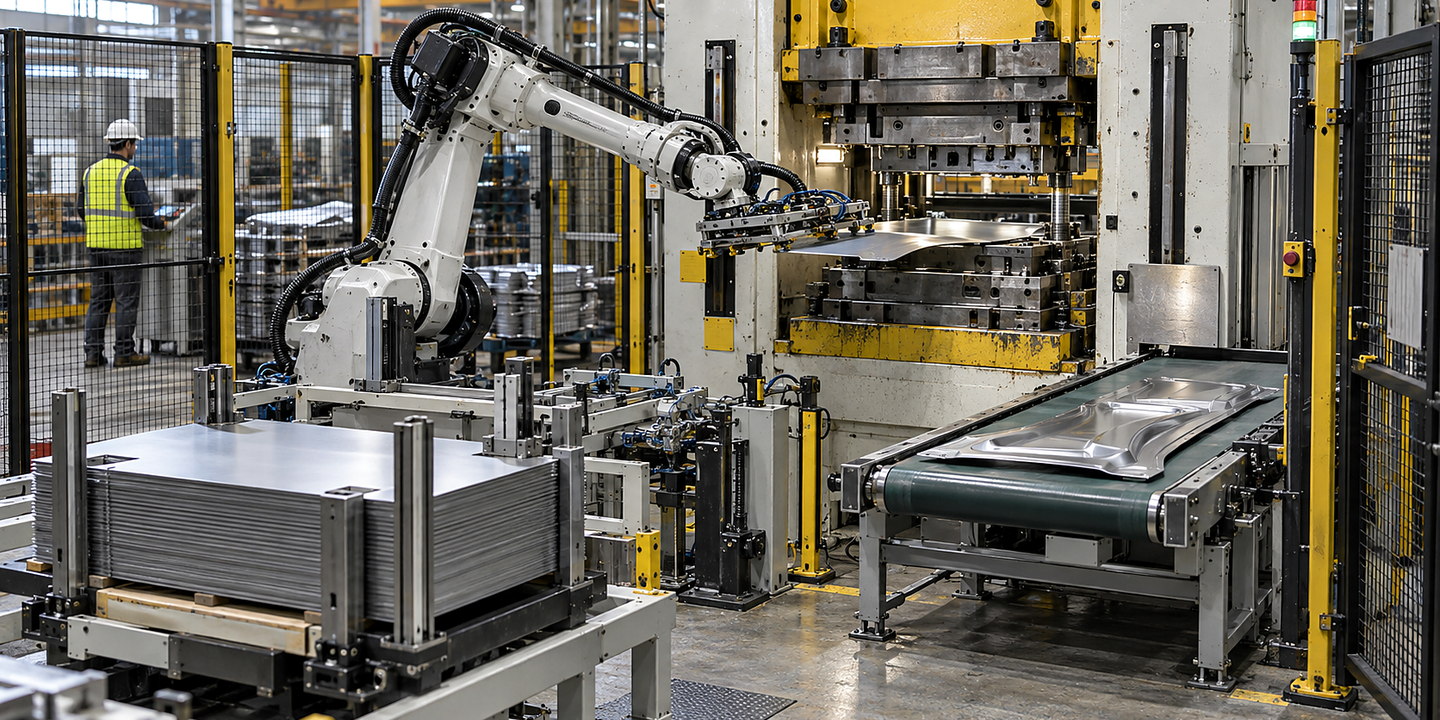
Compare robotic bottle transfer, dedicated mechanical handling and operator-assisted routes using actual bottles, handovers, line states and acceptance trials.
Compare robotic loading and transfer, dedicated mechanical handling and operator-assisted routes against the same bottle range and station handovers. Use actual empty/filled weights, surface and closure conditions, proposed grip points, orientation requirements and the response to missing or unstable bottles.
Start with the format and line-state brief and selection questions. Assess complete accepted transfers and operator work; the equipment category alone establishes neither bottle compatibility nor production output.
Plan robotic bottle handling around your parts, process, cycle time, tooling, recovery and acceptance criteria. Discuss the highest-risk feasibility questions with Oxford Industrial Automation. When you compare solutions, check how each option handles part, product and process variation for robotic bottle loading & transfer, arrival pattern and presentation and your surrounding line.
Discuss your application

Review actual bottle formats, empty and filled weights, surfaces, closures and required station orientations. Define accepted transfer/placement and the current conveyor and downstream pattern.
Compare robotic, dedicated mechanical and operator-assisted routes using the same bottles and handovers. Focus trials on uncertain grip points, transfer stability and receiving-station placement.
Coordinate pickup presentation, tooling, sensing, conveyor supply, downstream readiness and result checks. Include format-change tasks and controlled recovery from missing or unstable bottles.
Run representative formats and conditions through normal, waiting and interruption cases. Retain accepted-placement and bottle-condition results, then define training, support and later-change responsibilities.
Typical support: feasibility study, sample trials, cell design, offline build, integration and production ramp-up.
| Approach | Often suitable when | Watch for |
|---|---|---|
| Robotic Bottle Handling | The required bottle presentation, loading and transfer can be assessed for the intended formats and station handovers. | Prove proposed grip points, bottle condition, orientation and accepted placement with the actual line states. |
| Purpose-Built Mechanical Automation for a Stable, Very High-Volume Task | A stable bottle range and transfer task can be compared with a dedicated mechanical handling arrangement. | Check format variation, conveyor handovers, access, changeover and recovery under the same accepted-transfer criteria. |
| Operator-Assisted Fixtures where Flexibility or Business Case Does Not Support a Robot Cell | Defined operator tasks and handling fixtures may suit the format mix, order pattern and required flexibility. | Assess placement consistency, access, workload and missing/unstable-bottle handling; assistance alone does not establish suitability. |